
Here are today’s most important updates from the realm of Science and Space.
Glowing Gems on Mars? Scientists Stunned by Discovery
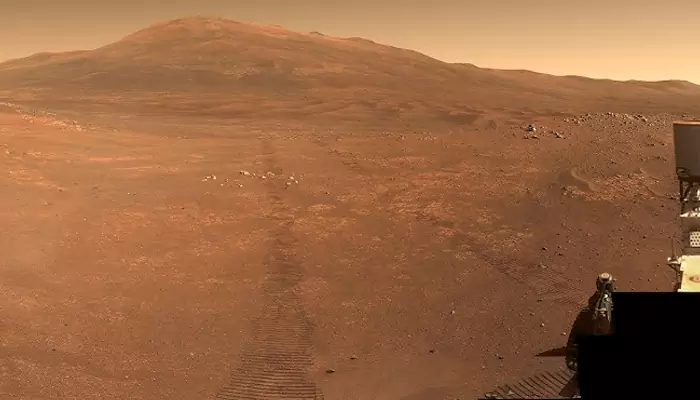
NASA's Perseverance rover has made a surprising discovery on Mars, finding tiny crystals of corundum, New Scientist reported. The minerals that form rubies and sapphires were embedded in Martian pebbles. This marks the first time such gems have been spotted on the Red Planet. The hints of the mineral were first spotted by Ann Ollila and her colleagues at Los Alamos National Laboratory in New Mexico. The discovery was made using the SuperCam instrument on the Perseverance rover, which analysed rocks like Hampden River, Coffee Cove, and Smiths Harbour.
Project Sunrise: Blue Origin’s Bold Bid to Dominate Orbit

Blue Origin, the space company founded by Jeff Bezos, has unveiled plans to build a massive satellite constellation aimed at taking data centres into orbit, marking a significant expansion of its ambitions beyond launch services. In a recent application filed with the US Federal Communications Commission (FCC), the company outlined Project Sunrise, a proposed network of up to 51,600 satellites designed to host orbital data infrastructure. According to the filing, the satellites will operate in sun-synchronous orbits at altitudes ranging between 500 and 1,800 kilometres. This type of orbit allows satellites to maintain consistent lighting conditions, which could be advantageous for power generation using solar panels.
ISRO Reveals Count of India’s Dead Satellites in Space

Union Minister Jitendra Singh, responding to a Parliament question on March 18, 2026, confirmed that a total of 129 trackable pieces of space debris originating from Indian missions are currently in orbit. That includes defunct satellites, spent rocket bodies, and fragments from a broken-up rocket stage. Of the 129 objects, 49 are defunct satellites. Twenty-three of these are in low Earth orbit (LEO) and 26 are in geostationary Earth orbit (GEO). The remaining debris includes rocket bodies from PSLV (40), GSLV (4) and LVM3 (3), along with 33 fragments from an in-orbit break-up of a PSLV-C3 rocket body.
Poor Sleep May Speed Up Brain Aging, Experts Warn

The quality of your sleep may do more than just affect how you feel in the morning; it could signal how quickly your brain is getting older. A new study from the University of California, San Francisco (UCSF) and Beth Israel Deaconess Medical Center has found that brain wave patterns recorded during sleep can help predict a person's risk of developing dementia. Amongst the significant findings were deep-sleep delta waves and sleep spindles. They are fast, short bursts of brain activity tied to memory and both play a role in brain age estimates. “Better body management, such as lowering body mass index and increasing exercise to reduce the likelihood of apnea, may have an impact," said the lead author. "But there's no magic pill to improve brain health.”