Here are today’s most important updates from the realm of Science and Space.
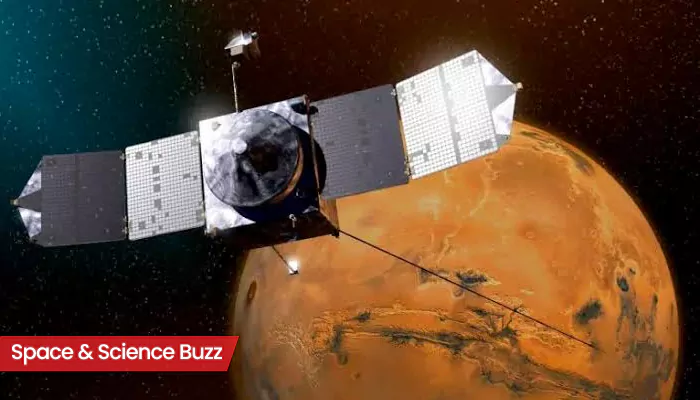
Red Planet Mystery: NASA’s MAVEN Spacecraft Suddenly Stops Responding
NASA’s Maven spacecraft, which has been orbiting Mars since 2014, lost contact with Earth-based ground stations. The loss of communication occurred on December 6 after Maven passed behind Mars, a phase known as occultation, during its regular orbit of the planet. Before the signal loss, telemetry data indicated that all spacecraft subsystems were functioning normally. After emerging from behind Mars, Maven failed to reestablish contact through Nasa’s Deep Space Network. The ground team monitoring the mission did not receive any signals, prompting immediate investigation into the anomaly by both spacecraft and operations teams.
Eerie Blue Streaks Flash Across Japan's Sky Moments After Massive Quake

Residents of rural Aomori Prefecture were left stunned on Wednesday night as bright blue flashes lit up the sky moments before a powerful 7.6 magnitude earthquake struck northern Japan. The eerie glow, captured on several mobile phone cameras, has reignited global curiosity about a rare natural phenomenon known as earthquake lights (EQL). Witnesses described the flashes as sudden streaks and pulses that illuminated the dark sky for several seconds. Scientists believe these mysterious lights may result from seismic stress generating electrical charges in the Earth’s crust, which then ionise the air above the ground.
Warming World: November 2025 Sets Climate Charts Ablaze

As the Northern Hemisphere steps hesitantly into winter, global temperatures in November 2025 told a different story, one of persistent warmth and record-breaking heat. According to the European Union’s Copernicus Climate Change Service (C3S), last month was the third-warmest November globally, continuing a streak of unprecedented warmth that has defined 2025. The average global surface air temperature in November 2025 stood at 14.02°C, which is 0.65°C above the 1991-2020 average for the month, based on data from the ERA5 reanalysis dataset. While it was 0.20°C cooler than November 2023, the warmest on record, and 0.08°C below November 2024, it still ranked among the hottest in the record. November’s temperatures were also 1.54°C above the pre-industrial baseline (1850–1900), making it the second consecutive month where global temperatures surpassed the 1.5°C threshold, a level central to international climate agreements.
The Nitrofuran Shock: What Scientists Found Inside Eggoz Eggs

Eggoz Nutrition, one of India’s leading premium egg brands, is in the eye of a controversy, after reports of its eggs testing positive for a chemical that is linked to cancer. Marketed for years as a provider of fresh, chemical-free eggs, the brand is now under intense scrutiny after a viral video by the YouTube channel Trustified, which routinely sends food and health products for independent lab testing. AOZ, or 3-amino-2-oxazolidinone, is a chemical metabolite formed when animals are treated with the nitrofuran antibiotic furazolidone. It binds to animal tissues and persists long after the original drug has broken down, which is why regulators treat AOZ as a marker showing that nitrofurans were used. Long-term studies have linked nitrofurans and their metabolites to potential carcinogenic and mutagenic effects in animals, prompting strict bans on their use in food-producing animals in many countries.