
The 10k Step Challenge: Why 'Non-Exercise' Movement is the Hero of World Obesity Day
- Devyani
- 7 months ago
- 3 minutes read
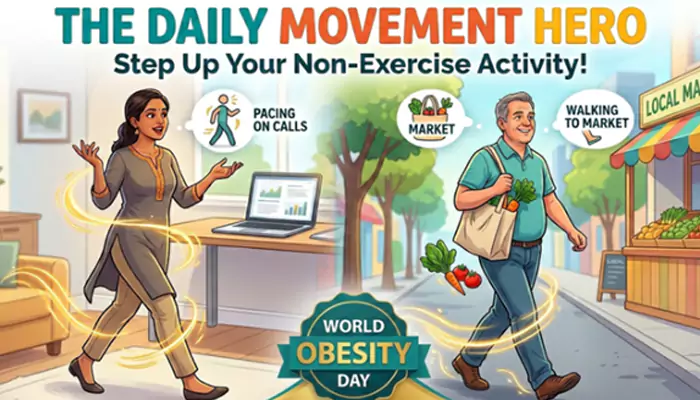
You don’t need a pricey gym membership to dodge the metabolic slump; sometimes, pacing during a stressful Zoom call does the actual heavy lifting.
Honestly, whoever invented the 10,000-step rule deserves a trophy. Not a medical one, mind you. A marketing one. It originated from a 1960s Japanese pedometer ad campaign that just stuck. We treat it like absolute gospel now.
You glance at your smartwatch at 8 PM, see a measly 3,200 steps, and instantly feel that familiar pang of modern guilt. Especially around World Obesity Day, the messaging gets so intense. We are conditioned to believe that if we aren't sweating buckets doing HIIT at 6 AM, we are failing our bodies. But biology? It turns out biology is way less dramatic than Instagram fitness influencers.
Enter the Invisible Workout

There is a concept called NEAT.
Non-Exercise Activity Thermogenesis. It’s a bit of a mouthful, I know.
Basically, it is the energy you burn doing absolutely everything that isn't sleeping, eating, or formal sports. It is the restless leg bouncing under your office desk. The frantic sweeping when relatives drop by unannounced. Pacing the balcony while trying to explain a tech issue to your broadband provider. That stuff adds up. Massively.
Science shows that these tiny, seemingly insignificant movements can account for a huge chunk of our daily energy expenditure. It is the ultimate jugaad for fitness.
The Kitchen vs. The Couch

Here is a very common Indian reality check. We get incredibly obsessive about our diets. We religiously cut out sugar from our morning tea, and we completely banish maida (white flour) from our kitchen cabinets, swapping it out for complex carbs or stevia drops. All fantastic choices, genuinely.
Yet, after eating that meticulously planned, flour-free, sugar-free lunch, what do we actually do? We sit. For seven straight hours. We optimize the fuel to perfection, but we leave the engine idling in the driveway. Human bodies just weren't designed to be desk-bound and screen-glued all day long.
Redefining the "Challenge"

So, maybe the whole 10k step challenge isn't really about hitting that exact, arbitrary number. Perhaps it's simply a clumsy, numerical way to remind us that we have legs.
Take the stairs when the society elevator is taking too long. Walk to the local sabzi mandi instead of instantly tapping a ten-minute grocery delivery app. Stand up when you take phone calls. It sounds ridiculously simple. Almost too basic to actually work. But this "non-exercise" movement is precisely what keeps the metabolic machinery running smoothly, without the intimidation factor of a crowded gym floor.
Keep the fitness tracker if gamifying your day helps you move. Just don't let the algorithms bully you. Because seriously, every single fidget counts.


.WEBP)
.WEBP)
.webp)
.WEBP)