Strong is the New Slim: Why We Need to Focus on Muscle Mass this World Obesity Day
- Devyani
- 7 months ago
- 3 minutes read
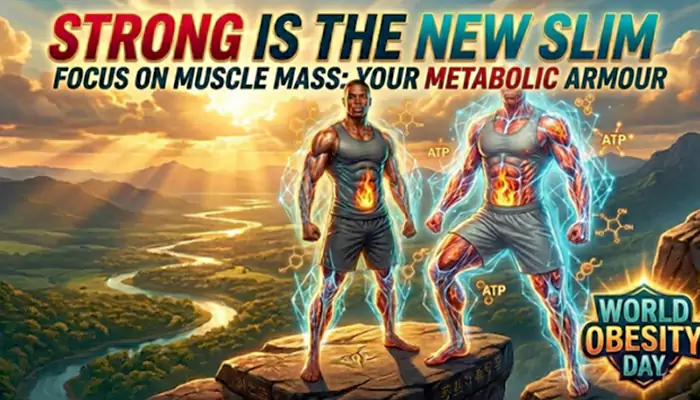
Forget the weighing scale for a minute. Here is why chasing a lower number is officially outdated, and building your body's metabolic armor is the only trend that matters.
So, someone at the last family get-together told you that you’ve become incredibly patla, and suddenly you are practically glowing. I get it. We are culturally conditioned to view shrinking - taking up less physical space - as the ultimate health victory.
But what exactly did you lose?
As World Obesity Day rolls around again, the internet is invariably flooded with the same tired BMI calculators and calorie-deficit infographics. Honestly, it’s exhausting. And, scientifically speaking, it’s missing the forest for the trees. We focus so obsessively on stripping away fat that we completely ignore the engine underneath: muscle mass.
The "Skinny-Fat" Paradox
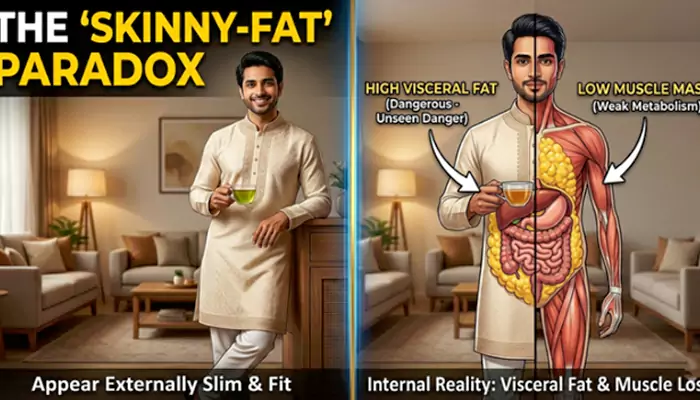
Here is a reality check that stings a bit. You can slide effortlessly into a slim fit kurta and still have metabolic health that looks like a slow-motion car crash.
It is called sarcopenic obesity. In colloquial terms? Skinny-fat.
In India, we are somewhat genetically predisposed to storing visceral fat (the dangerous kind around your organs) while having lower baseline muscle mass compared to other populations. When we diet - especially those brutal, crash diets involving endless cups of green tea and two Marie biscuits - we aren't just losing fat. We are cannibalizing our own muscles. Which is wild, if you think about it. You are literally burning down your house to keep warm.
Muscle as a Metabolic Fixed Deposit
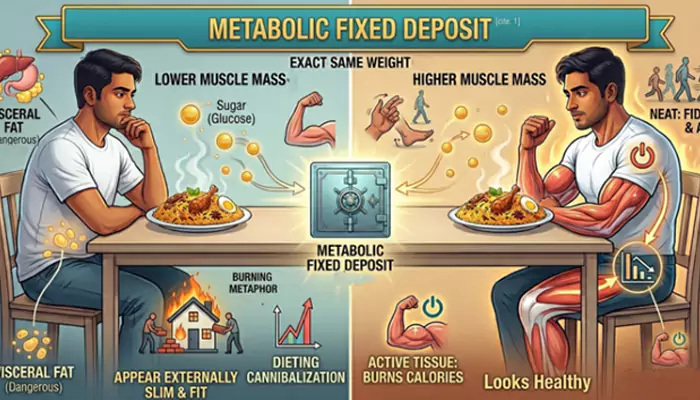
Think of muscle tissue as your body’s metabolic fixed deposit.
Fat just sits there. It’s passive storage. Muscle, on the other hand, is active. It costs your body calories just to maintain it. A person with higher muscle mass burns more calories while just sitting on the sofa watching Netflix than someone with lower muscle mass of the exact same weight.
Furthermore, muscle acts as a massive sink for glucose. Every time you eat a heavy meal - let's say, a massive plate of Sunday biryani - your muscles help clear that sugar from your bloodstream, reducing the insulin spike.
Rethinking the Kitchen
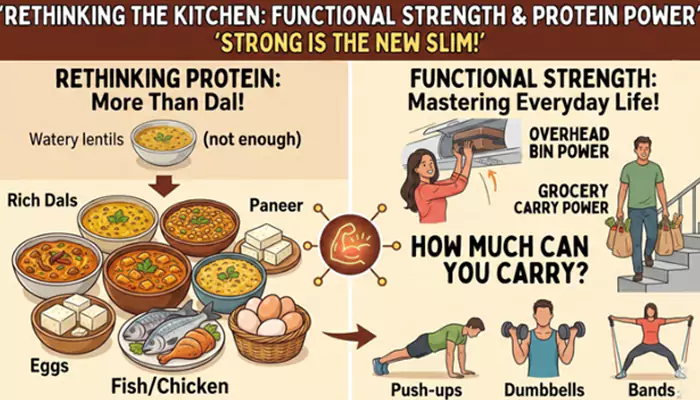
We need to talk about protein.
Our traditional diets, while rich in micronutrients, are heavily carb-tilted. Dal is great, absolutely. But relying on a small bowl of watery lentils to meet your daily protein quota is like trying to put out a campfire with a water pistol. It’s just not enough to build or even sustain functional muscle.
You don't need to suddenly become a bodybuilder. Nobody is asking you to start deadlifting small cars. But resistance training - whether that means lifting dumbbells, using resistance bands, or just mastering push-ups - is non-negotiable.
Perhaps it is time we flip the script.
Instead of asking, "How much weight did I lose?" the question really needs to be, "How much weight can I carry?" Can you comfortably lift your luggage into the overhead bin without pulling a shoulder? Can you carry your groceries up three flights of stairs?
Strong is the new slim. It’s functional. It’s resilient. And frankly, it’s a much better goal than just trying to disappear.